
How is AQI Calculated? Formulas, Sub-Index Methods, and Worked Examples

How exactly is India's Air Quality Index (AQI) calculated? Learn the 3 methods — the average formula, the 3-pollutant API, and the sub-index method — with the CPCB approach explained step by step.
Here, we walk through all three calculation methods clearly.
If you're new to the topic, start with what AQI is and what the 0–500 scale means before diving into the formulas below
The Core Concept: Sub-Indices
Before calculating a final AQI, a sub-index is calculated for each individual pollutant. Each sub-index represents that pollutant's concentration relative to its air quality standard — a kind of "how bad is this pollutant right now?" score.
The final AQI is the worst (maximum) sub-index value across all pollutants measured. This ensures the AQI always reflects the most harmful pollutant present — not an average that could mask a dangerous spike.
AQI = max(Sub-index₁, Sub-index₂, ..., Sub-indexₙ)The standards used as denominators in these formulas are drawn from India's National Ambient Air Quality Standards (NAAQS) — the legal concentration limits set by CPCB for 12 pollutants.
Method 1 — The Averaging Formula (n Pollutants)
When n major pollutants are being tracked, the Air Pollution Index (API) is the average of each pollutant's concentration expressed as a percentage of its standard:

Where:
Cᵢ = Measured concentration of pollutant i
Sᵢ = Air quality standard for pollutant i
I = Air Pollution Index
Interpretation: A value of 100 means the pollutant is exactly at its standard limit. Values above 100 mean the standard is being exceeded.

Example
Pollutant | Measured (Cᵢ) | Standard (Sᵢ) | Cᵢ/Sᵢ × 100 |
SO₂ | 40 µg/m³ | 80 µg/m³ | 50 |
NO₂ | 60 µg/m³ | 80 µg/m³ | 75 |
PM10 | 90 µg/m³ | 100 µg/m³ | 90 |
I = (50 + 75 + 90) / 3 = 71.7
Method 2 — The 3-Pollutant API Formula
When exactly three major pollutants (A, B, C) are considered, the formula is:

Where:
Cᵢ = Concentration of pollutant i
Sᵢ = Ambient air quality standard for pollutant i
This is mathematically identical to Method 1 with n = 3, but is commonly presented separately in exam syllabi since three-pollutant scenarios are the most frequently tested.
Method 3 — The Sub-Index Table Method (5 Parameters)
This method uses a lookup table to assign sub-index values to five measured parameters. Each parameter's reading falls within a range, and a corresponding sub-index (Aᵢ) is assigned.
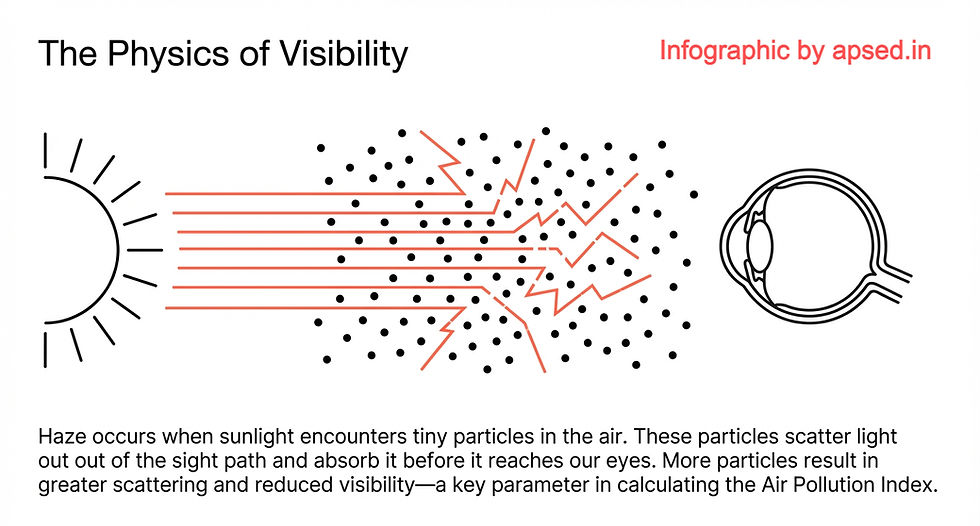
One of those five parameters is visibility — because air pollution directly reduces how far you can see through light scattering and absorption. Read more about how air pollution affects visibility and what COH measures.
Sub-Index Table
CO (ppm) | NO₂ (ppm) | Oxidant (ppm) | COH (units) | Visibility (km) | Sub-Index (Aᵢ) |
0 – 1 | 0 – 0.005 | 0 – 0.005 | 0 – 0.5 | 12 – 24 | 2 |
1 – 2 | 0.005 – 0.01 | 0.005 – 0.01 | 0.5 – 1.0 | 8 – 12 | 4 |
2 – 4 | 0.01 – 0.02 | 0.01 – 0.04 | 1 – 2 | 6 – 8 | 8 |
4 – 6 | 0.02 – 0.06 | 0.04 – 0.06 | 2 – 3 | 4 – 6 | 12 |
6 – 8 | 0.06 – 0.10 | 0.06 – 0.09 | 3 – 4 | 2 – 4 | 16 |
8 – 35 | 0.10 – 0.20 | 0.09 – 0.10 | 4 – 5 | 0 – 2 | 20 |
COH = Coefficient of Haze — a measure of particulate matter collected on a filter.
The final API is the sum of sub-indices for all five parameters:

Example
Parameter | Measured Value | Sub-Index (Aᵢ) |
CO | 3 ppm | 8 |
NO₂ | 0.05 ppm | 12 |
Oxidant | 0.07 ppm | 16 |
COH | 1.5 units | 8 |
Visibility | 5 km | 12 |
API = 8 + 12 + 16 + 8 + 12 = 56
According to India's AQI scale, a value of 56 falls in the Satisfactory category.
How CPCB Calculates the Final AQI (Official Method)
India's Central Pollution Control Board (CPCB) follows this procedure for the official national AQI:
Measure concentrations of up to 8 pollutants at a monitoring station
Calculate sub-indices for each pollutant using 24-hour mean values (8-hourly for CO and O₃)
The worst (highest) sub-index = Final AQI for that monitoring location
Minimum data requirements:
At least 3 pollutants must be measured
At least one of those three must be PM2.5 or PM10
At least 16 hours of data is needed to compute a valid sub-index
If these conditions aren't met, AQI is not reported — though individual pollutant sub-indices may still be published.

The Final AQI Formula
When multiple calculation methods are in play, the final AQI is taken as:
AQI = max(Method 1 AQI, Method 2 AQI, ..., Method n AQI)This maximum operator ensures the reported AQI always reflects the most conservative (worst-case) assessment of air quality.
Limitations of AQI Calculation
Even with a robust formula, the AQI has real-world limitations:
Manual data entry at some stations introduces human error
Data may vary across time and measurement tools, giving inconsistent values
Power cuts and maintenance failures at monitoring stations can disrupt data
Calibration errors in sensors lead to inaccurate sub-indices
Exam Tip
Focus on:
Being able to apply Method 1 (the averaging formula) with given Cᵢ and Sᵢ values
Understanding the sub-index concept and the maximum operator rule
The data sufficiency requirement (3 pollutants, one must be PM₂.₅ or PM₁₀, 16 hrs minimum)
Further Reading
On this blog:
External resources:


Comments